





If you’re trying to increase loyalty engagement, birthday campaigns look like an easy win—until you realize most of them feel generic, hit the wrong people, or become “just another coupon.” The difference between a forgettable birthday blast and a retention-friendly moment is timing, relevance, and a clean automation system. Here’s how to build customer birthday campaigns your customers actually want to use—without over-discounting or over-emailing.
Learn timing, reward ideas, segmentation, and email examples to automate birthday campaigns that feel personal and support loyalty engagement.
The Birthday Campaign Checklist (what to decide before you build anything)
Before you touch a template or pick an offer, make a few decisions that will keep your birthday automation from turning into an awkward, noisy “coupon machine.”
What counts as a “birthday campaign” (offer, perk, message, or moment)
A birthday campaign doesn’t have to be a discount. It can be any intentional “moment” that makes a customer feel recognized. In practice, birthday campaigns usually fall into one of these buckets:
- Offer: A code or reward that encourages a purchase within a window.
- Perk: A non-discount benefit (free gift, upgrade, points boost, early access).
- Message: A simple note that reinforces brand warmth and loyalty (sometimes with no incentive).
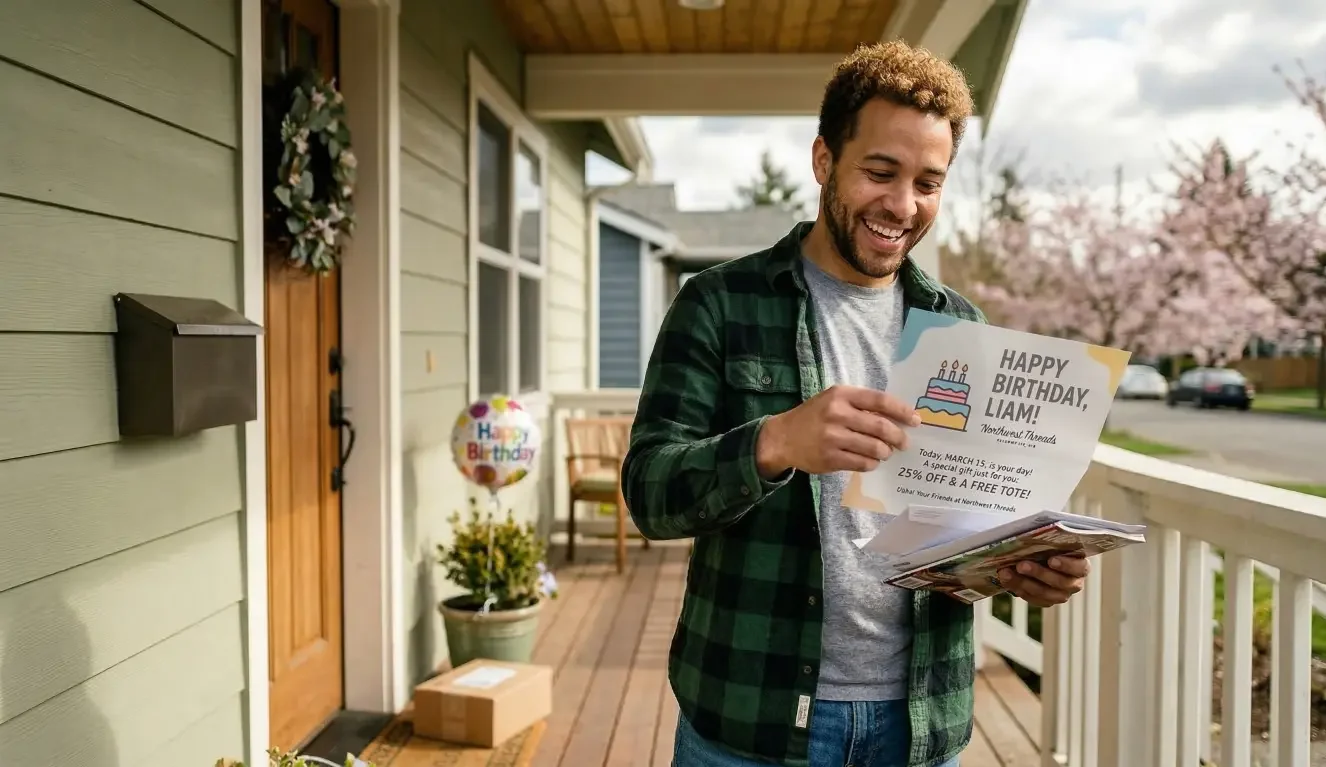
- Moment: A coordinated experience across channels (email + SMS + direct mail postcard, for example), designed for recall.
If loyalty engagement is your trigger, think “moment” first. Offers can work, but the goal is not just a one-day spike—it’s strengthening the relationship.
Decide your goal: loyalty engagement vs. immediate redemption (TBD KPI definitions)
Birthday automation is easiest when there’s one primary goal. Choose one:
- Loyalty engagement: Reinforce “I’m a valued customer,” improve future responsiveness, and bring customers back without depending on heavy discounts.
- Immediate redemption: Drive a purchase tied to a short window around the birthday.
Both goals can be valid, but they create different decisions about timing, offer size, channel mix, and how often you communicate. Your exact KPI definitions will depend on your platform and purchase cycle (TBD). The important part is committing to a primary goal so you don’t design a campaign that is confusing to measure and hard to optimize.
Start with the data: how to collect and validate birthdays without friction
The biggest birthday campaign failure isn’t creative—it’s data. If birthdays are missing, wrong, duplicated, or scattered across systems, automation becomes risky.
Where birthday data usually lives (POS, e-comm, loyalty, email forms)
Birthday data typically shows up in a few places:
- POS / in-store profiles: Often incomplete or inconsistent because collection depends on staff and customer willingness.
- E-commerce account profiles: Can be reliable if customers maintain accounts, but many check out as guests.
- Loyalty program enrollment: Usually the best context for collecting birthdays because it’s clearly tied to benefits.
- Email signup forms: Useful, but only if you have a good reason and clear framing.
If you have multiple sources, choose one “source of truth” for automation rules. Otherwise, you’ll accidentally message people twice—or not at all.
Minimal data rules (format, consent context, deduping) (TBD specifics)
You don’t need to over-engineer, but you do need a few basic rules so automation behaves predictably:
- Standardize the date format in whatever system triggers the campaign.
- Deduplicate contacts so one person doesn’t get multiple birthday sends across multiple emails.
- Set a default behavior for missing birthdays (e.g., no send, or a “birthday month” alternative only if appropriate).
- Track the source of the birthday field if possible (loyalty sign-up vs. account profile) so you can troubleshoot.
The specific implementation details vary by platform (TBD). But the best mindset is: a birthday campaign is only as good as the data feeding it.
The “ask” problem: how to request birthdays without feeling creepy
Customers are cautious about personal data—and birthdays can feel sensitive if you don’t explain why you want it.
The simplest approach is a clear value exchange:
- “Share your birthday and we’ll send a birthday perk.”
- “Add your birthday to unlock a gift during your birthday month.”
- “Tell us your birthday so we can make your loyalty perks more personal.”
A few practical tips:
- Ask in contexts where it makes sense: loyalty sign-up, account completion, or post-purchase profile completion.
- Avoid forcing it at checkout unless your audience expects it.
- Don’t ask for full birth year if you don’t need it. If “month/day” is enough, keep it minimal.
Timing ideas that feel thoughtful (not last-minute or robotic)
Timing is what separates a nice brand moment from a generic blast. You’re not just deciding when to send—you’re deciding how a customer experiences the offer.
Pre-birthday heads-up (for planners)
A pre-birthday email works best when:
- Customers plan purchases (apparel, gifts, bigger carts).
- Your product has consideration time.
- You want the campaign to feel like a perk, not a last-minute coupon.
Common approach: send a short heads-up a few days before the birthday with a clear window, so the customer has time to use it.
Day-of message (simple and direct)
Day-of messages work when:
- Customers buy impulsively or routinely.
- The perk is simple to redeem.
- You want the message to feel celebratory and easy.
Keep day-of messaging clean: warm, short, and obviously redeemable.
Post-birthday grace window (for busy customers)
A grace window acknowledges reality: people miss emails, travel, get busy, or don’t shop on their birthday.
Post-birthday reminders are most useful when:
- Your goal is loyalty engagement more than a strict “birthday day” event.
- You want to avoid urgency pressure.
- Your audience has longer purchase cycles.
The tone matters here. “In case you missed it” is softer than “last chance.”
Choosing a redemption window that protects margin (no benchmarks)
There’s no universal “best” window. A tight window can drive urgency, but it can also increase pressure and unsub risk if you overdo it. A longer window is friendlier but may reduce urgency.
Choose your window based on:
- How often customers naturally purchase
- How margin-sensitive your category is
- How strongly your brand leans into “celebration” vs “promotion”
If you’re worried about discount dependency, lean toward perks, thresholds, or category-limited offers rather than broad sitewide discounts.
Rewards and offers: what to give without turning it into discount addiction
Your reward design is the heart of the campaign. The wrong reward trains customers to wait for coupons. The right reward feels like recognition and nudges the next purchase naturally.
Non-discount perks (early access, free gift, upgrade, points boost)
Non-discount perks often work well for loyalty engagement because they feel special without directly cutting price. Examples include:
- Free gift with purchase (especially if the gift is brand-relevant, not random)
- Free upgrade (faster shipping tier, premium packaging, gift wrap)
- Points boost for loyalty members during the birthday window
- Early access to a new product drop or limited collection
- VIP service perk (priority support, easy returns, reserved appointment slot)
These perks tend to work best when your brand can deliver experience—not just price.
Smart discounts (thresholds, category limits) (TBD examples)
Discounts aren’t automatically bad. The risk comes from broad, repeated discounts that reshape customer expectations.
“Smart discounts” are structured so they:
- Protect margin
- Encourage profitable behavior
- Feel like a perk rather than a clearance sale
Examples that can be adapted by category (TBD):
- Spend threshold rewards that lift basket size
- Category-limited discounts for higher-margin products
- Bundled offers that create value without deep cuts
Because margins and category economics vary, specific discount structures should be decided with your business context in mind (TBD examples).
Match offer type to purchase cycle (fast-moving vs. seasonal categories)
Offer choice should reflect how customers buy.
- If your products are replenished often, your birthday campaign can nudge a routine reorder.
- If your category is seasonal or high-consideration, your campaign should feel like early access, a perk, or a longer window.
A mistake many marketers make is treating every category like a fast-moving consumer product. The best birthday campaigns fit the rhythm of buying behavior.
Segmentation: one birthday offer is rarely right for everyone
The fastest way to make birthday campaigns feel generic is to send the same offer to everyone. Segmentation doesn’t have to be complex to be effective.
New customers vs. repeat customers
These two groups need different messaging.
- New customers: Your goal is often to create a second purchase and reinforce trust. Keep it simple and easy.
- Repeat customers: Your goal is recognition and deepening loyalty. Consider perks that feel “earned” or VIP-adjacent.
If you can only do one segmentation split, start here.
VIP/loyalty members vs. casual buyers
Birthday campaigns are a natural place to reinforce loyalty programs:
- Loyalty members can receive a more “exclusive” perk (points boost, early access, VIP gift).
- Casual buyers can receive a lighter, simpler incentive that encourages re-engagement.
This creates a subtle message: loyalty has benefits beyond random promos.
High AOV vs. margin-sensitive categories (TBD rules)
If you sell both high-margin and tight-margin items, it’s risky to use a single offer.
A safer approach is to:
- Tailor the reward to category (e.g., perks for margin-sensitive lines)
- Use thresholds or bundles for higher-cost items
- Reserve stronger perks for segments where it’s sustainable
Exact segmentation rules depend on your economics and customer behavior (TBD rules).
Common failure modes (and how to prevent them)
Birthday campaigns fail in predictable ways. Fixing them is usually about reducing friction and preventing misfires.
Duplicate sends, wrong dates, missing fields
This is where brand trust can get damaged quickly.
Prevent it with simple safeguards:
- One source of truth for the birthday field
- A “sent this year” suppression rule
- Dedupe logic for contacts with multiple emails
- A QA view that lets you preview who will receive the next send
Even if your campaign is fully automated, you should have a basic monitoring step—especially early on.
Over-emailing and deliverability risk (safe cadence language)
Birthday campaigns can quietly increase sending volume. If you stack birthday sends on top of already-heavy promotional calendars, you may create fatigue.
A safe approach:
- Keep the birthday sequence short
- Avoid adding multiple reminders unless your audience expects it
- Watch engagement signals and unsub trends as you scale
Start targeted and expand. You’re trying to build loyalty engagement, not another reason to unsubscribe.
Generic creative that doesn’t connect to the customer
“Happy Birthday” emails become noise when they look like every other template.
Small improvements that make a difference:
- Reference the customer’s relationship (“Thanks for being a customer”)
- Align the design with your brand voice (not stock celebration clipart)
- Make the perk easy to understand in one glance
Personal doesn’t mean creepy. It means relevant and respectful.
Offer rules that are hard to redeem (friction kills engagement)
If customers have to jump through hoops, they won’t redeem.
Watch for friction like:
- A code that only works in certain carts but isn’t explained
- Redemption rules buried in fine print
- Offers that require too much spend for the average customer
- Checkout limitations that create confusion
A birthday offer should feel like a gift, not a negotiation.
Email examples and simple automation flows you can copy
You don’t need a complicated lifecycle build to start. You need clear messaging, a sensible timing choice, and a reliable trigger.
Subject lines and message structure (without hype)
Subject lines that tend to feel human:
- “A birthday perk from us 🎉”
- “Happy Birthday, [First Name] — here’s something small”
- “Your birthday gift is ready”
- “A little thank-you for your birthday week”
Keep the email structure simple:
- Short warm opening
- One clear perk
- How to use it
- When it expires (if applicable)
- A gentle reminder of why they’re receiving it (“as a customer / member”)
3 mini-templates: pre-bday, day-of, last-chance
Pre-birthday (heads-up)
Subject: “Your birthday perk is coming this week”
Body:
“Hi [First Name], your birthday is coming up, so we wanted to send a small perk early.
Use [perk/offer] anytime between [start date] and [end date].
It’s our way of saying thanks for being part of [brand].
[Button: Claim your birthday perk]”
Day-of (simple and direct)
Subject: “Happy Birthday, [First Name] 🎉”
Body:
“Happy Birthday! Here’s a small gift from us: [perk/offer].
Use it by [date]—no complicated rules.
[Button: Use your birthday perk]
Thanks for being with [brand].”
Last-chance (grace reminder)
Subject: “In case you missed it—your birthday perk ends soon”
Body:
“Quick reminder: your birthday perk is still available until [date].
If you want to use it, here’s the link—simple and fast.
[Button: Redeem birthday perk]”
You can adjust the tone by segment: loyalty members get slightly more “exclusive” language; new customers get clearer instructions and less insider phrasing.
“First win” add-on for loyalty engagement (optional)
If loyalty engagement is the trigger, consider a “first win” follow-up that doesn’t feel like a promo. For example:
- A short reminder of points progress (if loyalty-based)
- A curated recommendation based on what they browse
- A “members-only” perk framed as recognition
The goal is to connect the birthday moment to the ongoing relationship, not just a one-off coupon.
Adding direct mail birthday postcards (when it makes sense)
Direct mail birthday postcards aren’t for every brand. But they can be a meaningful touchpoint when email alone feels crowded or your audience responds to physical reminders.
Which segments are worth a physical touchpoint
Direct mail is most sensible for:
- VIP customers or high-value segments
- Customers who haven’t engaged digitally but are still valuable
- Local retail customers who can redeem in-store
- Brands with strong visual identity where a physical piece reinforces recall
Rather than sending postcards to everyone, start with a targeted segment where the cost makes sense and the experience fits your brand.
Postcard timing and messaging alignment with email
A postcard should feel like part of the same campaign, not a separate promotion.
Common approaches:
- Postcard arrives around the birthday week while email handles immediate links/codes
- Postcard reinforces the perk with simple redemption instructions
- Both channels share the same tone and visual identity
If you’re running a grace window, postcards can support that “friendly reminder” without piling on more emails.
Operational notes (lead times, address quality) (TBD specifics)
Direct mail requires a few operational realities:
- You need clean addresses (or a way to improve them)
- You need enough lead time for printing and mailing
- You need a redemption mechanism that is easy to use
Exact logistics vary by provider and workflow (TBD specifics). The practical rule is: keep the postcard simple and aligned to what the customer already sees in email.
How to measure success responsibly (and what to adjust first)
Birthday campaigns are easy to measure poorly. Opens and clicks can be interesting, but they’re not the full story—especially if your goal is loyalty engagement.
Behavior signals vs. vanity metrics (opens vs. redemptions vs. repeat) (TBD definitions)
To evaluate the campaign, prioritize behavior signals:
- Did customers redeem the perk?
- Did the campaign bring customers back within the window?
- Did customers continue purchasing after the birthday moment?
Opens and clicks can help you diagnose creative and deliverability issues, but they don’t prove the campaign improved customer behavior. Your exact definitions will depend on your tools and purchase cycle (TBD definitions).
Simple test design: offer type, timing window, segment
If you want to improve the campaign, test one variable at a time:
- Offer type: perk vs threshold discount vs category-limited reward
- Timing: pre-birthday vs day-of vs grace reminder
- Segment: new vs repeat vs loyalty members
Keep tests small and intentional. The goal is not to find a universal winner—it’s to find what fits your brand and customer behavior.
Proof posture: what evidence to look for before scaling
Before you scale the campaign to more segments or add more messages, look for evidence that:
- Customers understand and use the offer without confusion
- You aren’t increasing unsubscribes or complaints
- The program isn’t training customers into discount dependency
- The message feels aligned with your brand tone
Scaling too early is how birthday campaigns become noisy and generic. Improve the core flow first.
Where MailX2 fits: automating birthday moments from real engagement signals
Birthday campaigns work best when they feel personal and consistent. That usually requires two things: richer customer context and automation that triggers at the right time without manual list pulls.
MailX2 is designed to help businesses convert anonymous website visitors into measurable leads and customers through real-time visitor identification and automated email + direct mail campaigns. Its system identifies visitors, builds richer profiles, and triggers tailored outreach based on engagement.
Visitor identification + profile enrichment to support personalization
A common gap in birthday campaigns is that personalization is limited to “first name + coupon.” When you can connect birthday messaging to actual engagement signals (what the customer browsed, how often they return, what categories matter), campaigns can feel more relevant without being invasive.
MailX2 supports workflows where customer engagement signals can inform segmentation and messaging, which is especially useful when birthday data exists but customer context is thin.
Triggered email + direct mail orchestration as a managed workflow
For teams that want a coordinated moment, MailX2 can support a managed approach to triggering email sequences and physical mail pieces based on visitor engagement and profile data—so birthday campaigns are not a once-a-month manual project.
The emphasis here is reliability: a campaign that fires correctly, targets the right segment, and stays consistent over time.
Practical flow: visit → identify → segment → birthday sequence (TBD specifics)
A practical birthday automation flow often looks like:
- Visitor engages with key pages or products
- They become identifiable through the system and their profile is enriched
- They are segmented based on purchase history or engagement signals
- A birthday sequence runs based on timing rules and offer logic
The exact structure depends on your data sources, segmentation rules, and reward choices (TBD specifics). But the aim is the same: make the birthday moment feel intentional and consistent without creating more manual work.
The next best step if you want this running in 2–3 weeks
If birthdays are part of your loyalty engagement strategy, the hardest part is making it consistent: clean data, correct timing, and follow-up that doesn’t feel spammy.
MailX2 helps you identify engaged visitors, build richer profiles, and trigger coordinated email + direct mail touchpoints automatically.
In a walkthrough, we’ll map your timing windows, reward rules, and segments—then show a practical automation flow you can actually run.
Book a birthday automation walkthrough to get a clean plan.
Get a sample birthday email + postcard sequence
FAQ
What are customer birthday campaigns and why do they work for loyalty engagement?
Customer birthday campaigns are automated messages and perks tied to a customer’s birthday window. They can support loyalty engagement because they create a personal-feeling moment of recognition and give you a natural reason to follow up—when the offer, timing, and segmentation fit the customer relationship.
When should you send birthday emails—before, on, or after the birthday?
It depends on customer behavior and your goal. Pre-birthday messages help planners and longer purchase cycles. Day-of messages work for simple perks and fast decisions. Post-birthday grace windows help busy customers and can feel more friendly—especially when loyalty engagement is the priority.
What are good birthday rewards that don’t rely on heavy discounts?
Non-discount perks can work well: free gifts with purchase, upgrades, points boosts, early access, or VIP service perks. If you use discounts, consider structured options like thresholds or category limits (TBD examples) so the offer encourages profitable behavior rather than constant coupon expectations.
How do you automate birthday email campaigns if birthday data is incomplete?
Start by choosing a single source of truth for birthday data and standardizing the format. Then build automation rules that suppress duplicates and avoid sending when required fields are missing. Over time, improve data collection through loyalty enrollment and account completion—framed as a clear value exchange.
Should you use direct mail birthday postcards along with email?
Sometimes. Postcards can make sense for VIP segments, high-value customers, local retail audiences, or brands where physical recall matters. The best approach is to test direct mail in a targeted segment rather than sending to everyone.
How do you measure a birthday campaign without relying on vanity metrics?
Prioritize behavior signals like redemptions and return purchases during the birthday window, and watch for downstream repeat behavior. Use opens and clicks to diagnose creative and deliverability, but don’t treat them as proof of retention impact. Compare results across segments and timing choices to guide improvements.
Book a MailX2 birthday automation walkthrough
RELATED LINK:
USPS — Every Door Direct Mail (EDDM) overview (if you ever use route-based drops)