

When retention starts slipping, most small businesses respond with more promos—yet repeat customers still don’t come back. The issue often isn’t “lack of discounts,” but the absence of a clear reason to return and a system to follow up consistently. A loyalty program can help—but only if it matches how your customers actually buy and you can measure whether it’s changing behavior.
If you’re a small retail or e-commerce owner (or the person running marketing), this guide walks through what loyalty programs really do, the main program types, how to choose incentives without training customers to wait for discounts, and how to track progress without getting lost in vanity numbers.
Loyalty programs for small businesses are very useful if used the right way.
Why retention feels harder lately (and what loyalty programs can actually change)
Retention can feel like it’s getting harder even when your product is good and your customer service hasn’t changed. That’s because “good” doesn’t automatically translate into “habit.” Loyalty programs don’t magically fix retention—but they can influence a few important levers that retention depends on.
Loyalty ≠ discounts: the difference between “incentive” and “habit”
Discounts are a short-term incentive. They can create a spike, but they don’t always create a reason to return unless the next purchase is already likely.
A loyalty program, at its best, does something different:
- It gives customers a reason to come back that isn’t just “there’s a sale.”
- It rewards repeat behavior in a structured way.
- It makes the relationship feel recognized—especially for customers who buy more than once.
In other words: discounts can create urgency; loyalty programs can create continuity.
The real role: repeat-trigger + recognition + reminders
Most retention problems come down to one (or more) of these:
- Customers don’t have a clear trigger to buy again.
- Customers don’t feel any difference between buying once and buying twice.
- Customers forget you—even if they liked you.
A well-fit loyalty program supports all three:
- Repeat-trigger: a reason to return (a reward, a milestone, a tier, a perk).
- Recognition: “You’re part of something,” not just another order number.
- Reminders: the program gives you legitimate, customer-friendly reasons to follow up (progress updates, perks, points, early access).
That last one matters more than many SMBs expect. You can have a loyalty program on paper—but if customers don’t remember it, it won’t change behavior.
First, define the retention problem you’re trying to solve
“More repeat customers” sounds simple—until you try to design a program. The right loyalty model depends on what’s actually happening in your business.
Low second purchase vs. low frequency vs. low spend on repeats
Retention issues tend to show up in a few patterns:
- Low second purchase: Lots of first-time buyers, but few people come back at all.
- Low frequency: Customers return, but far less often than you’d expect.
- Low spend on repeats: Customers come back, but repeat orders are smaller, or only happen when there’s a discount.
These patterns should shape your loyalty program choice.
- If your problem is low second purchase, your loyalty program needs a strong “first win” and a reason to make purchase #2 happen soon.
- If your problem is low frequency, your program needs progress, status, or perks that encourage consistent returns.
- If your problem is low spend on repeats, your incentives may need smarter thresholds, bundles, or category rewards—without eroding margin.
“I need more repeat customers” → translate into a measurable goal (TBD metrics)
You don’t need a complicated analytics setup to start—but you do need a clear target. Before you pick a loyalty structure, decide what you want to move.
Examples of goals (choose one primary):
- Increase the share of customers who make a second purchase.
- Reduce the time between first and second purchase.
- Increase the number of customers who buy multiple times within a set period.
- Increase average order value among repeat customers.
Your specific metric definitions will depend on your store, order cycle, and tools (TBD). The point is: your loyalty program should be built to move one clear behavior first—then you can expand.
The main loyalty program types (and who each one fits)
There’s no “best loyalty program.” There’s only the best fit for your customers, margins, and operations. Here are the major models most SMB retail and e-commerce businesses consider.
Points-based (simple earn/burn)
What it is: Customers earn points from purchases and redeem them for rewards.
Best fit when:
- You have a broad customer base and want something easy to understand.
- Your product line supports repeat purchases.
- You can afford small, consistent rewards without damaging margin.
Tradeoffs:
- If rewards are too small, customers don’t care.
- If rewards are too generous, you train customers to buy only when redeeming.
- Points programs can become “set it and forget it”—and then customers forget too.
Scenario fit: A Shopify brand selling skincare, supplements, or accessories often chooses points because it’s familiar and easy to explain. But it works best when paired with simple progress and reminders.
Tiered / VIP (status + exclusivity)
What it is: Customers unlock levels (Silver/Gold/VIP) based on spend or frequency, with increasing perks.
Best fit when:
- You have a meaningful “high value” segment you want to retain.
- Customers like recognition and exclusivity (even small touches can matter).
- You have enough margin to offer perks that feel special.
Tradeoffs:
- Requires clearer communication and tracking.
- If tiers feel impossible to reach, customers disengage.
- Perks must be valuable but sustainable.
Scenario fit: A local boutique with a POS system can run a VIP tier with early access events, reserved items, or priority service—perks that feel personal without always being discounts.
Punch card / visit-based (fast feedback loop)
What it is: Buy X times, get Y. The value is simplicity and speed.
Best fit when:
- Customers purchase frequently (or can purchase frequently).
- You want a short cycle to motivate the next visit quickly.
- Your business runs on routine behavior.
Tradeoffs:
- Can be too basic for high-consideration purchases.
- Less effective when purchases are spaced far apart.
- Needs an easy way to track (especially across online + in-store).
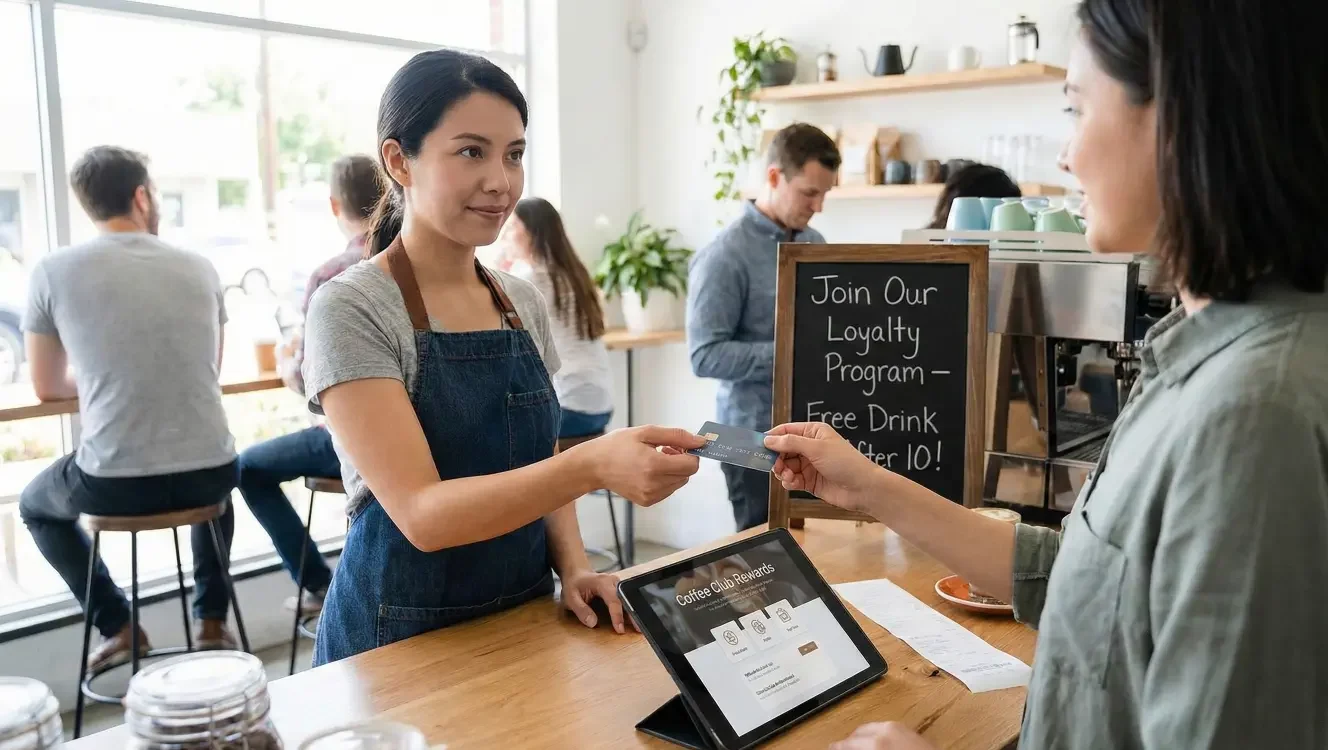
Scenario fit: For a small retailer with repeat foot traffic (coffee add-ons, gift shop items, convenience categories), punch card logic can outperform complex points because customers understand it instantly.
Membership / paid loyalty (commitment model)
What it is: Customers pay a membership fee to get ongoing benefits.
Best fit when:
- You have strong brand affinity or frequent purchases.
- Your perks are clearly valuable (shipping perks, service perks, exclusive products).
- You can consistently deliver benefits without heavy discounting.
Tradeoffs:
- Harder to sell if you don’t already have trust.
- Needs careful positioning so customers feel it’s worth it.
- Adds operational complexity (support, fulfillment, consistency).
Scenario fit: A niche e-commerce brand with loyal repeat customers can use membership to stabilize retention—if the benefits are clear and consistently delivered.
Referral-led loyalty (friend-get-friend)
What it is: Customers earn rewards for referrals, sometimes layered with points or tiers.
Best fit when:
- Your customers genuinely recommend you already.
- Your product has clear “share” value.
- You can fulfill rewards quickly and fairly.
Tradeoffs:
- Doesn’t always fix retention by itself—acquisition-focused.
- Can be gamed if not designed carefully.
- Needs tight rules and clean tracking.
Scenario fit: Brands with strong community or giftability often use referral programs as a loyalty layer—but it shouldn’t be the only retention strategy unless your repeat behavior is already strong.
Incentives that work without training customers to wait for discounts
Retention concerns often push SMBs into heavier promos. Loyalty incentives can reduce that pressure—but only if the incentives are designed to reinforce repeat behavior, not discount dependency.
Non-monetary perks (early access, priority service, personalization)
Non-monetary rewards can be powerful because they feel exclusive without directly cutting price. Examples include:
- Early access to new products or limited drops
- VIP-only bundles or “members-only” items
- Free gift wrapping, personalization, or upgrades
- Priority support or faster handling
- Birthday perks that feel personal (not just a coupon)
These work best when your customers care about experience, identity, or convenience—not just price.
“Smart discounts” (thresholds, bundles, category-specific) (TBD examples)
Discounts aren’t bad. They’re just risky when they become your only retention tool.
“Smart discounts” are designed to move a behavior while protecting margin:
- Threshold-based rewards that encourage larger baskets
- Category-specific rewards that focus on higher-margin items
- Bundles that create value without heavy price cuts
- Rewards that require a second purchase (so you move repeat behavior)
Exact examples will depend on your margins and product mix (TBD). The key is choosing incentives that create a reason to return—not a reason to wait.
The measurement layer: what to track so you know it’s working
A loyalty program can feel “busy” because people sign up. But signups are not the same thing as retention.
To know whether your loyalty program is helping, focus on behavior metrics, not just activity metrics.
What to measure at minimum (repeat rate, time-to-second purchase, redemption behavior) (TBD definitions)
At minimum, you want to track:
- Repeat behavior: Are more customers buying again?
- Time-to-second purchase: Are customers coming back sooner?
- Redemption behavior: Are customers redeeming rewards (and does redemption correlate with repeat purchases)?
Your specific definitions will depend on your platform and purchase cycle (TBD). But the principle is consistent: if your loyalty program is working, it should show up in repeat patterns, not just in enrollments.
The analytics trap: vanity signups vs. behavior change
It’s easy to feel progress when:
- You get a big spike in loyalty enrollments.
- Emails have decent open rates.
- Customers claim rewards.
But the real question is: are customers buying again more often—or sooner—because of it?
If enrollment is high but repeat behavior is flat, the program may have one of these problems:
- Rewards aren’t meaningful.
- The program is confusing.
- Customers forget they’re enrolled.
- Your follow-up isn’t consistent enough to keep the program top-of-mind.
Proof posture: how to verify uplift responsibly (before/after, cohorts) (TBD specifics)
You don’t need perfect attribution to make better decisions. A practical way to verify impact is:
- Compare repeat behavior before and after launch.
- Compare cohorts (customers who enrolled vs those who didn’t).
- Watch for unintended outcomes (margin pressure, discount dependency, churn in certain segments).
The details of cohort setup and timing will depend on your tools (TBD). The point is to build a simple measurement loop: run → observe → adjust → repeat.
Common loyalty program pitfalls (especially for SMBs)
Retention concerns often lead SMBs to launch something quickly. The fastest loyalty program to launch is not always the easiest one to maintain—or the one customers will actually use.
Too complicated to explain at checkout
If customers can’t understand the program in one sentence, they won’t adopt it.
This is especially true in-store. Your staff (or you) shouldn’t need a script longer than a breath:
- “Earn points every purchase and redeem for rewards.”
- “Buy five times, get a free bonus.”
- “VIP customers get early access and special perks.”
If the explanation gets complicated, simplify the structure or reduce options.
Rewards that crush margin or never get redeemed
A loyalty program fails in two opposite ways:
- Rewards are so generous you lose margin.
- Rewards are so weak nobody redeems them.
Both lead to disappointment. Sustainable loyalty incentives often start smaller and get refined over time—based on redemption behavior and customer response.
No follow-up system (customers forget they’re enrolled)
This is one of the most common reasons loyalty programs underperform.
Customers don’t live inside your store. Even happy customers forget. Your job is to remind them, without being annoying, that:
- They have progress.
- They’re close to a reward.
- They have perks waiting.
Without reminders, loyalty becomes invisible.
Data gaps between website, POS, and email list (TBD scenarios)
If your customer data is split across systems, your loyalty program can become inconsistent:
- Customers earn points in-store but don’t see them online.
- Online customers don’t get recognized in-store.
- Email campaigns don’t reflect loyalty status.
How this shows up depends on your setup (TBD), but the impact is the same: customer trust erodes when loyalty feels unreliable.
Loyalty program email campaigns that don’t feel spammy
Email is often where loyalty programs either become effective—or become noise. The goal isn’t to send more emails. It’s to send the right emails at the right time, tied to customer behavior.
Enrollment → “first win” sequence
If you want to reduce retention anxiety, focus on the second purchase.
A practical loyalty sequence after enrollment might include:
- A welcome message that explains the benefit in one sentence
- A “first progress” nudge (e.g., “You’re already X% toward your first reward”)
- A simple recommendation or reminder based on what they browsed or bought
The purpose is to help customers feel the program immediately—so it becomes real.
Points reminder, tier progress, replenishment timing (where relevant)
Useful loyalty emails tend to be progress-driven, not promo-driven:
- Points balance reminders (only when it matters)
- “You’re close” progress nudges
- Tier progress updates (status is motivating when it feels achievable)
- Replenishment reminders (only if your products fit this model)
Start with a light cadence and adjust based on engagement signals and customer behavior. The goal is sustained recall, not constant contact.
Win-back vs. loyalty: when to use each
A loyalty program supports ongoing retention. A win-back campaign addresses lapse.
If a customer hasn’t returned within your normal cycle, win-back messaging may be appropriate. But don’t confuse the two:
- Loyalty messaging reinforces ongoing progress and perks.
- Win-back messaging acknowledges a gap and offers a reason to return.
When retention concerns rise, many businesses overuse win-back discounts. Loyalty can reduce that reliance—if it’s paired with consistent follow-up.
Where MailX2 fits: turning loyalty into consistent multi-channel follow-up
A loyalty program is only as strong as your ability to stay connected to customers in a way that feels timely and relevant.
MailX2 is designed to help businesses convert anonymous website visitors into measurable leads and customers by identifying engaged visitors and triggering automated follow-up across email and direct mail—creating consistent touchpoints after real engagement.
Identifying engaged visitors and triggering tailored sequences
A common loyalty problem for e-commerce (and many SMB websites) is that visitors browse, show intent, and disappear—without joining the loyalty program or making a second purchase.
MailX2 can support workflows where behavior triggers follow-up:
- A visitor browses key categories or returns multiple times
- They enter a tailored email sequence that invites loyalty enrollment, highlights a perk, or reinforces product fit
- The sequence can be adjusted by interest signals (what they viewed, how often they came back)
This supports the “reminders” role of loyalty: staying top-of-mind based on real engagement.
Pairing email automation with direct mail for recall (when it makes sense)
For some audiences, a physical touchpoint can reinforce recognition—especially when inboxes are crowded. Direct mail isn’t always necessary, but it can make sense when:
- Your average order value supports it
- Your brand benefits from tactile recall
- You’re targeting higher-value segments or VIPs
The safest approach is to test it in targeted segments rather than rolling it out broadly.
Practical workflows: “browse → enroll prompt → reminder → reward nudge” (TBD specifics)
A practical retention workflow often looks like:
- Website engagement (browse / return visit / cart behavior)
- A loyalty invitation that matches interest
- A “first win” follow-up that pushes toward purchase #2
- Progress reminders tied to actual milestones
- Reward nudges that feel helpful, not pushy
The exact structure depends on your store and offer (TBD), but the core idea is consistent: loyalty works better when follow-up is automatic and timely.
A simple decision checklist: pick your model in 15 minutes
If you’re feeling retention concerns, you don’t need to overthink your first version. You need a reasonable fit you can actually run—and then improve.
If you’re retail foot-traffic heavy → start here
Choose something simple and fast:
- Punch card / visit-based rewards
- A basic VIP tier for top customers
- Non-monetary perks that feel personal (priority service, early access, small upgrades)
Make it easy for staff to explain and easy for customers to remember.
If you’re e-comm repeat purchase heavy → start here
Lean toward:
- Points-based programs with clear earn/burn
- Tiered VIP programs if you have a meaningful high-value segment
- A strong post-enrollment “first win” sequence to push purchase #2
The key is pairing the program with consistent, behavior-based reminders.
If you’re margin-sensitive → start here
Avoid heavy blanket discounts. Instead:
- Use non-monetary perks where possible
- Use smart thresholds and bundles rather than “percent off everything” (TBD examples)
- Limit generous rewards to specific categories or tiers
Your loyalty program should protect margin while still feeling valuable.
Get a loyalty follow-up plan you can actually run
Worried retention is sliding but not sure what lever to pull first?
MailX2 helps you turn engaged website visitors into identifiable contacts and trigger follow-up automatically.
We’ll map a simple loyalty follow-up flow—who gets what message, when, and why—so you can run it without constant manual work.
Book a walkthrough to see what this could look like for your store.
FAQ
What are the most effective loyalty program types for small businesses?
The most effective small business loyalty programs are the ones that match your customer behavior and your operational reality. Points-based programs are often easiest for e-commerce. Punch card programs work well for frequent in-store purchases. Tiered VIP programs can be strong when you have a meaningful high-value segment and can offer sustainable perks.
Are points-based programs better than tiered VIP programs for retention?
Points-based programs are usually simpler and better for broad participation. Tiered VIP programs can be better for retaining your best customers because status and exclusivity can feel more motivating than points alone. The right choice depends on whether you’re trying to lift overall repeat behavior or protect and grow your top segment.
What loyalty program rewards work without hurting margins?
Non-monetary perks (early access, priority service, personalization) often protect margin better than blanket discounts. If you use discounts, consider smarter structures like thresholds, bundles, or category-specific rewards (TBD examples) so incentives drive profitable behavior rather than constant price cuts.
How do I measure whether my loyalty program is working?
Track a small set of repeat-behavior metrics consistently so you can compare periods or customer cohorts. At minimum, watch repeat purchasing patterns, time-to-second purchase, and whether redemption behavior is associated with more frequent returns. Avoid focusing only on enrollment numbers or email activity.
What are the most common loyalty program pitfalls for SMB retail and e-commerce?
Common pitfalls include making the program too complicated, offering rewards that either crush margin or feel too weak, and failing to follow up so customers forget they’re enrolled. Another major issue is inconsistent data across systems (website, POS, email list), which can make loyalty feel unreliable.
How should loyalty program email campaigns be structured after sign-up?
Start with an enrollment sequence that delivers a quick “first win” and nudges toward the second purchase. Then use occasional, progress-based reminders (points balance, tier progress, “you’re close” nudges) rather than constant promos. Keep cadence light at first and adjust based on engagement and customer behavior.
Book a MailX2 retention walkthrough
See a sample loyalty follow-up sequence (email + mail)
RELATED LINKS:
United States Postal Service Every Door Direct Mail (EDDM) overview for businesses.