


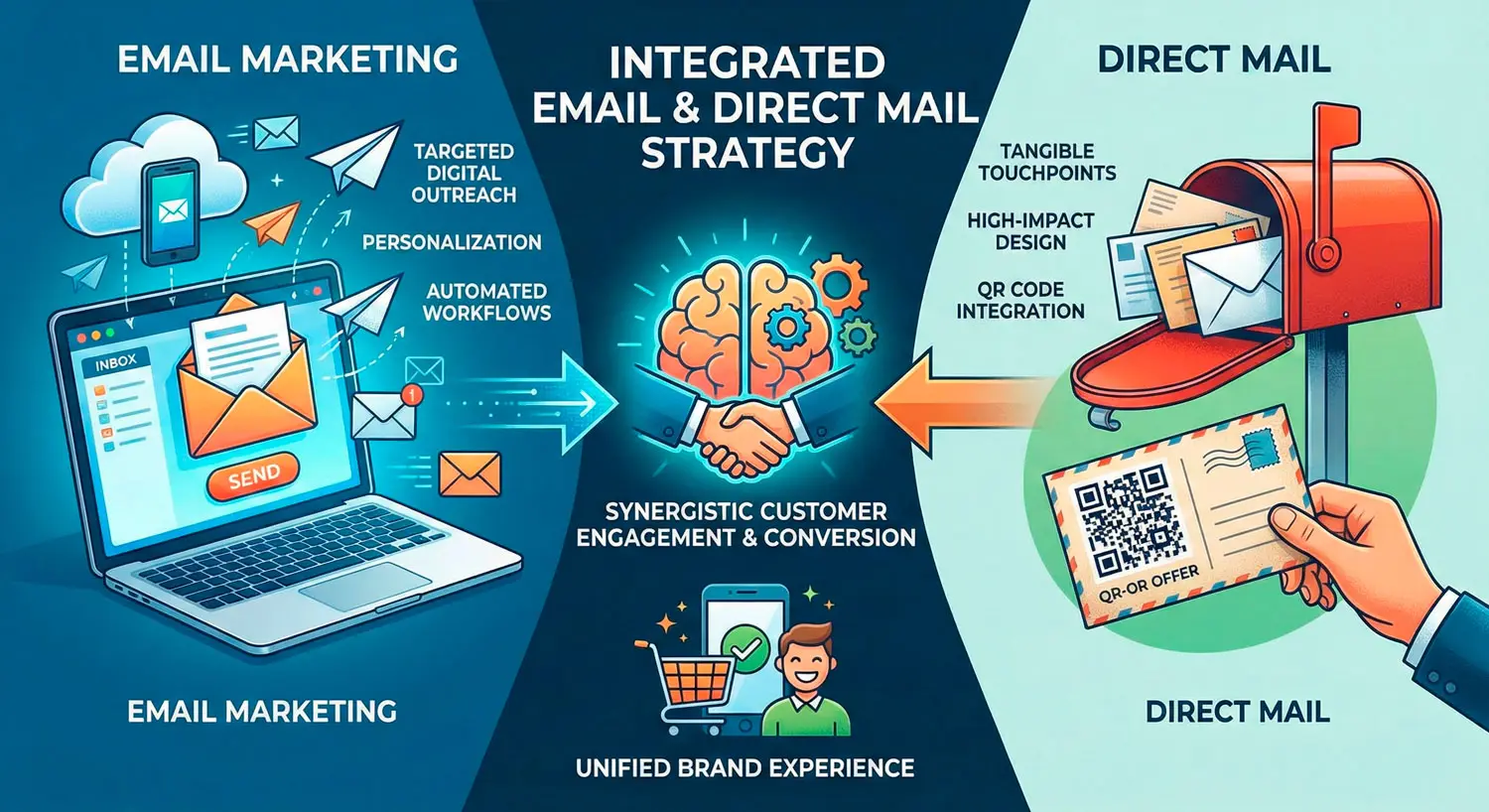
Why Channel Choice Is So Hard for Automotive Dealerships (needs an Email and Direct Mail strategy)
The Pressure to Prove Every Marketing Dollar
If you run or manage a dealership, your marketing budget never feels purely “marketing.” It’s payroll, floorplan, and next quarter’s profitability all wrapped into one line item. Every dollar has to defend itself.
You’re juggling OEM programs, third-party leads, search, social, and whatever “next big thing” vendors are pitching you. When costs rise or sales soften, it’s natural to look for channels you can cut. Email looks cheap and quick. Direct mail looks effective but expensive. The temptation is to simplify: keep one, drop the other.
That instinct makes sense—but it can quietly cap the results you get from the customers who are already in your database and already familiar with your brand.
Email, Direct Mail, and the Myth of the “One Right Channel”
Most pitches are framed like a debate: inbox vs mailbox. The truth is less dramatic. Email and direct mail are tools that behave differently:
- Email is fast, flexible, and low cost per touch.
- Direct mail is slower to deploy but more tangible and visible inside the home.
Neither is “right” in every situation. For day-to-day communication, email usually wins. For big, high-value campaigns, direct mail often pulls more weight. And for some of your most important opportunities—lease-end, equity, dormant customers—using both together often makes more sense than picking a side.
The real question isn’t “Which channel is better?” It’s “Which moments in your customer journey deserve both, and which are fine with one?”
What Email Does Best for Auto Dealers
Speed, Flexibility, and Low Cost per Touch
Email is your dealership’s quick-response channel. You can:
- Announce a weekend service special by Thursday afternoon.
- Follow up with a sales guest the same day they left the showroom.
- Share a digital brochure or video for a model a customer just test-drove.
You can segment by vehicle interest, service history, geography, or last visit date. You can test subject lines and adjust timing without printing or postage. For a busy dealership, that agility is hard to beat.
Because email is relatively inexpensive per send, it’s ideal for:
- Frequent touches that keep you top-of-mind.
- Transactional messages (confirmations, reminders).
- Short “nudges” that move a customer one step closer to booking or buying.
Best-Fit Email Use Cases in a Dealership
Some dealership campaigns are almost always email-first:
- Service reminders and follow-ups
“You’re due for an oil change,” “We saw you in service last month—here’s your inspection recap,” “We noticed you declined tires; here’s a reminder of your options.” - Post-visit and post-sale communication
Thank-you messages, satisfaction surveys, review requests, and check-ins after a purchase or service visit. - Digital brochures and shopping support
Vehicle detail pages, comparison guides, finance FAQs, and trade-in tools, all linked from a single email. - Appointment confirmations and updates
Confirming test drives, service appointments, and letting customers know about any changes or recommendations.
These are all moments where speed, clarity, and convenience matter more than a physical piece of mail.
Where Email Alone Starts to Hit Its Limits
Email isn’t perfect. You’ve probably seen:
- Inbox fatigue: Even well-intentioned customers are flooded with messages from retailers, apps, and other dealers. Yours can be easy to ignore.
- Low open or engagement on generic blasts: Large, undifferentiated lists and “one-size-fits-all” offers rarely perform as well as targeted campaigns.
- Messages getting buried: Even if a customer intends to act, your email can disappear under new messages in a matter of hours.
- Short attention spans: Long, complex offers or multi-step explanations may not land well in a quick inbox scan.
For lower-value touches, those limitations are acceptable. But when the opportunity is big—like a lease-end or equity campaign—relying on email alone often feels risky.
What Direct Mail Does Best for Auto Dealers
Tangible Impact and Household Visibility
Direct mail lands in a very different environment: the home. A well-designed postcard, letter, or folded mailer can sit on a kitchen counter or fridge for days. Even if the recipient doesn’t respond immediately, your message has time to breathe.
For many people, a physical mailer:
- Feels more substantial than another email.
- Is easier to show to a spouse or family member.
- Can be revisited when they’re ready to talk about a purchase or service.
This is especially important for big decisions—buying, leasing, upgrading, or committing to a service plan—where the conversation extends beyond a single person and a single moment.
Best-Fit Direct Mail Use Cases in a Dealership
Direct mail shines when you need impact and staying power:
- Lease-end notifications and upgrade offers
A clear, personalized notice that a lease is ending soon, outlining options and inviting the customer to review choices. - Equity and trade-up campaigns
Informing customers that they may be in a favorable equity position and could move into a newer model or lower payment. - Big sales events and tent-pole promotions
Holiday events, grand openings, remodel announcements, or “once a year” offers where you want maximum visibility. - New store or showroom updates
Inviting nearby households to visit a new location or see a refreshed facility.
In these scenarios, a physical piece in the home can feel more official and harder to ignore than another email.
Where Direct Mail Alone Falls Short
At the same time, direct mail has real constraints:
- Higher cost per touch: Printing and postage mean you can’t mail everyone, all the time.
- Longer lead times: Creative, list prep, printing, and mailing all take advance planning.
- Limited ongoing follow-up: A single mailer can’t answer follow-up questions or adapt based on recipient behavior.
- Harder to “fix” mid-campaign: Once it’s mailed, it’s mailed; you can’t easily change the offer or message for that batch.
That’s why many dealerships use direct mail sparingly—but when used alone, it can end up as a one-and-done push that doesn’t connect with as many people as it could.
Why Your Dealership Often Needs Both Email and Direct Mail
How Combined Channels Change Customer Response
When a customer sees a consistent offer in their inbox and their mailbox, a few things tend to happen:
- They recognize your campaign faster: “Oh, this is that lease-end offer they emailed me about.”
- They’re more likely to remember key dates: a service special ending, a sale weekend, a lease maturity month.
- They have options for how to respond: click a link from email, call the number on the mailer, or simply walk in.
The combined effect isn’t about “doubling” response in a literal sense. It’s about:
- Reaching people who prefer different formats.
- Repeating an important message in a way that doesn’t feel like spam.
- Making your offer feel more real and considered.
“Either/Or” vs “Email + Mail”: A Practical Comparison
Consider a lease-end campaign:
- Email only:
You send a series of messages to upcoming maturities. Some customers open, some don’t. The message is easy to miss in a busy inbox. - Mail only:
You send a single letter or postcard. It has presence, but if that moment doesn’t line up with when the customer is ready to talk, the opportunity may pass quietly. - Email + mail together:
You mail a clear lease-end notice and reinforce it with an email series before and after the mail drop. The message feels coordinated. The customer sees it more than once, in more than one place.
The right mix will vary by dealership, but this kind of side-by-side comparison often reveals where combined channels are likely to earn their keep.
When Combined Channels Make the Most Sense
It rarely makes sense to run every campaign in both channels. Combined email + mail is most justified when:
- The potential value per customer is high (lease-end, trade-up, or new vehicle purchase).
- The campaign is tied to a specific window (event dates, lease maturities).
- Multiple people in the household are involved in the decision.
- You’re trying to reactivate dormant but valuable past customers.
For lower-stakes messages, email alone usually remains the most efficient option.
Budgeting for a Combined Email + Direct Mail Strategy
Right-Sizing Your Mail Spend Around Key Moments
The goal isn’t to layer direct mail on top of every email. Instead:
- Identify a small number of high-value campaigns each year—lease-end, equity, major events—where a physical piece is most likely to matter.
- Use direct mail for carefully selected segments, not your entire database.
- Treat mail as a way to amplify your most important messages, rather than as a general broadcast channel.
This approach lets you control costs while still strengthening the campaigns that matter most.
Using Email to Extend and Support Direct Mail Campaigns
Email can be structured to support and extend each mail drop:
- Pre-mail emails:
Set context—“Look out for a special offer arriving in your mailbox this week”—so the piece is less likely to be overlooked. - Post-mail follow-up:
Remind customers about the offer, answer common questions, and provide easy ways to respond (schedule a visit, reply, click to call). - Behavior-based nudges:
If your system detects that someone visited a campaign landing page or opened an email but didn’t act, you can send a tailored follow-up.
Used this way, email doesn’t compete with direct mail. It acts like connective tissue that helps each mailed piece work harder.
Practical Budget Scenarios for Small and Mid-Sized Dealerships
Every store is different, but a simple way to think about it is:
- Reserve a portion of your budget for “always-on” email—service reminders, post-visit follow-ups, and basic sales communication.
- Set aside a separate, smaller pool specifically for combined email + mail campaigns tied to key moments.
- Plan those combined campaigns on a calendar so they don’t collide with each other or with OEM pushes.
You don’t need a complex spreadsheet to get started; even a rough plan helps you avoid random spending and keep both channels aligned.
Realistic Campaign Examples for Auto Dealers Using Both Channels
Lease-End and Equity Campaigns
Imagine a customer whose lease matures in six months:
- They receive an initial letter explaining their options and inviting them to schedule a conversation.
- Shortly after, they get an email with similar messaging plus links to models that match their current payment range.
- As the maturity date approaches, follow-up emails offer appointment times, while a second mailer may highlight a special event or loyalty incentive.
The combined approach gives them time, information, and multiple ways to respond—without overwhelming them.
Service Lane Retention and Upsell
For service retention:
- Email handles regular maintenance reminders, thank-you messages after a visit, and basic offers.
- A few times a year, a well-timed mailer might highlight a bundled maintenance plan, tire specials, or seasonal checks.
Customers who have drifted away from your service lane may be more responsive to a tangible reminder in the mail, especially when it feels tailored to their vehicle and history.
Big Sale Events and New Model Launches
For a major sales event or new model launch:
- Direct mail can deliver a “save the date” or invitation with creative that stands out at home.
- Email can provide countdown reminders, more detail on inventory, and quick links to schedule test drives.
The result is a campaign that feels coordinated rather than fragmented—a story told over multiple touches instead of a single blast.
Avoiding Common Mistakes with Email + Mail in Dealership Marketing
Over-Messaging the Same People Without a Plan
When you add a second channel, it’s easy to accidentally double your volume instead of doubling your clarity. Common pitfalls include:
- Sending too many touches in a short window.
- Repeating the exact same copy across every message.
- Failing to suppress people who have already responded.
A simple contact plan—who gets what, when, and why—helps keep your campaigns assertive but respectful.
Treating Email and Mail as Separate Campaigns
Another risk is running email and direct mail in separate silos:
- Different lists, different offers, different creative.
- No shared calendar or coordination.
From the customer’s perspective, this can feel disjointed or confusing. If a mailer offers something different from an email they just received, they may ignore both.
Treat each combined campaign as one story, delivered in two formats. Align offer, timing, and call-to-action so the experience feels intentional.
Ignoring Data from Your Own Website and CRM
Your best lists often come from data you already have:
- Website visitors who looked at specific vehicles or tools.
- Customers coming up on a service interval or lease maturity.
- Past buyers who haven’t been back in a while.
If email and mail campaigns are built without tapping into this information, you may send generic messages that feel out of sync with what customers actually want.
Even simple segmentation—by last visit date, vehicle type, or location—can make both channels more relevant and more welcome.
How Automation and Visitor-Driven Triggers Make Combined Channels Manageable
From Manual Campaigns to Triggered Sequences
Running every email and mail touch manually is hard for any dealership team. Automation can help by:
- Triggering sequences based on dates (lease maturity, purchase anniversary, service intervals).
- Reacting to behaviors (online vehicle searches, trade-in inquiries, finance page visits).
- Ensuring customers don’t fall through the cracks between departments.
The goal isn’t to replace human judgment. It’s to handle repetitive, time-sensitive communication so your team can focus on conversations that require a personal touch.
Using Website Visitor Behavior to Trigger Email + Mail Journeys
When your systems can connect website behavior with your CRM and campaigns, new possibilities open up. For example:
- Someone who spends time on a specific SUV model page might enter a short email sequence that highlights that model’s features and invites a test drive.
- A visitor who uses the trade-in tool could receive follow-up that explains next steps and—when appropriate—a targeted mail piece reinforcing the offer.
- A customer exploring finance options online can receive guidance about approvals and programs relevant to their situation.
These journeys don’t have to be complex. Even simple “if this, then that” triggers can make campaigns feel more timely and relevant.
Where a Managed Platform Like MailX2 Fits In
Managing visitor behavior, email, and direct mail on your own can be a lot to ask of a small marketing team. A managed platform like MailX2 is designed to:
- Help identify visitors and connect their behavior to contactable profiles where appropriate.
- Trigger email and direct mail sequences based on that behavior and your dealership’s goals.
- Provide support around campaign setup, creative, and ongoing adjustments.
The point isn’t that every dealership needs a specific platform. It’s that visitor-driven automation can make a combined email + mail approach realistic, even for smaller teams—especially when paired with guidance rather than left as a DIY project.
Deciding Your Channel Mix: A Simple Framework for Dealership Owners
When to Use Email Only
Email alone is usually enough when:
- The message is routine (service reminders, appointment confirmations).
- The stakes are relatively low for each individual response.
- You need to move fast (e.g., a last-minute weekend offer or weather-related service update).
If you’re unsure, ask: “If this email gets modest engagement, is that acceptable given the value of the offer?” If the answer is yes, email-only is likely appropriate.
When to Use Direct Mail Only
Direct mail on its own can still be the right choice when:
- You’re targeting a very specific, high-value group in a limited geography.
- You want to make a strong statement about a store opening, renovation, or community engagement.
- You have limited or outdated email data for the audience you’re trying to reach.
In these cases, the physical presence of the piece may carry the message sufficiently, especially if your operations team is ready to handle responses by phone and in-person.
When to Commit to a Combined Email + Mail Strategy
A combined approach is most worth the extra effort and cost when:
- The potential revenue per customer is high, such as equity and lease-end campaigns, major model launches, or big event sales.
- You have enough data to coordinate both channels (email addresses, mailing addresses, basic segmentation).
- You’re willing to commit to a simple, repeatable plan rather than a one-off experiment.
If the campaign affects a core part of your business—like retention, upgrade cycles, or flagship events—it’s often worth asking, “What would it look like to support this with both email and direct mail, in a planned way?”
Building an Email + Mail Strategy You Can Actually Run
You don’t need to choose a winner between email and direct mail. Each plays a different role:
- Email keeps your dealership present in customers’ day-to-day lives and handles the bulk of your ongoing communication.
- Direct mail gives key campaigns extra weight and visibility inside the home.
For your most important opportunities, combining both can help your offers land more clearly and more consistently—without requiring a huge team or an unlimited budget.
The path forward isn’t about adding complexity. It’s about choosing a handful of campaigns where combined channels make sense, building simple sequences around them, and letting automation handle the repetitive work. From there, you can refine based on what fits your market, your team, and your goals.
If you’re ready to move beyond the “either/or” channel debate and see what a coordinated, visitor-driven email + mail approach could look like for your store, the next step is to look at your calendar, your database, and your current campaigns with fresh eyes.
FAQ content
- Why should an automotive dealership use both email and direct mail instead of just one channel?
Because email and direct mail behave differently, they tend to reach customers in different ways. Email is fast, flexible, and inexpensive, making it ideal for ongoing communication and quick updates. Direct mail is more tangible and visible in the home, which can be especially helpful for high-value campaigns like lease-end or equity offers. Using both together on carefully chosen campaigns can help more customers notice and remember your message without requiring you to double every send. - What dealership campaigns work best with a combined email and direct mail strategy?
Combined channels are most useful for campaigns where the potential value per customer is high and the timing matters. Common examples include lease-end and equity campaigns, big event sales, new model launches, and reactivation efforts for dormant but valuable customers. Email provides frequent, low-cost touches, while direct mail gives these campaigns additional weight and visibility. - How can small or mid-sized auto dealers budget for both email and direct mail?
A practical approach is to separate your budget into two buckets: one for “always-on” email (service reminders, follow-ups, everyday communication) and a smaller, dedicated pool for combined email + mail campaigns tied to key moments. Instead of mailing everyone all the time, use direct mail for carefully chosen segments and campaigns, while email handles the lighter, more frequent touches. - When is email alone enough for dealership marketing, and when do I need direct mail too?
Email alone is usually enough for routine updates, service reminders, appointment confirmations, digital brochures, and other messages where speed and convenience matter most. Direct mail becomes more important when you’re running a high-stakes campaign, reactivating dormant customers, or communicating something that may benefit from being physically present in the home. If the opportunity is significant and time-bound, it’s worth considering whether a mail piece would help. - How does automation help manage email + mail sequences for auto dealers?
Automation can trigger communication based on dates and behaviors, such as lease maturities, service intervals, or online vehicle browsing. Instead of manually scheduling every touch, you can set up sequences that send the right email at the right time and, where appropriate, coordinate direct mail as part of that journey. This helps small teams run more consistent, timely campaigns without creating an unmanageable workload. - How can I decide the right channel mix for my dealership’s next big campaign?
Start by clarifying the goal and value of the campaign, the timeline, and who you need to reach. If the opportunity is high-value and involves a decision that may include multiple people in the household, it’s a strong candidate for a combined email + mail approach. If it’s more routine or experimental, email alone may be enough. From there, map out a simple contact plan: who receives email only, who receives both, and how you’ll measure engagement across channels.
If you’re debating your dealership’s channel mix, you don’t have to guess which campaigns deserve both email and mail.
Book an email and direct mail strategy call with MailX2.
We’ll review your current campaigns, budget, and database, then outline a simple, combined-channel plan you can actually run—with clear ideas for where visitor-driven email and direct mail may fit next.