





Most marketing teams don’t decide between DIY and managed automation on a 3-year horizon. They decide on a single budget cycle:
- “This ESP is cheaper than that one.”
- “We already have a CDP; let’s bolt more on.”
- “We’ll wire up visitor ID, email, SMS, and direct mail ourselves.”
Meanwhile, martech stacks keep expanding and underperforming. Gartner’s 2025 survey found martech utilization at just 49%, meaning more than half of licensed capabilities go unused. Adobe/PK research saw enterprises using around 130 applications with overlapping functionality and estimated roughly 44% of marketing SaaS licenses are underutilized or not used at all. Other analyses describe martech “sprawl” as expensive, bloated, and barely used.
This is where the DIY vs managed automation choice becomes strategic. The real question is not “What does this tool cost this year?” but “What does this operating model cost us over three years, in tools, people, risk, and speed?”
This article gives you a CFO- and COO-friendly way to answer that question. We’ll compare:
- A DIY multi-channel stack (ESP + CDP/CRM + SMS + direct mail API + visitor ID + routing + reporting).
- A managed multi-channel service (visitor identification + email + direct mail + strategy + execution, MailX2-style).
Using a 3-year cost curve, you’ll see where each model wins, where it loses, and how to structure a 90-day evaluation that finance can sign off on.
Why Multi-Channel Automation Decisions Need a 3-Year Lens
The lifecycle of martech: from adoption to entropy
New tools start out exciting: a demo, a launch, some early quick wins. Then reality sets in:
- Integrations need maintenance.
- “Temporary” workarounds become permanent.
- Admin ownership changes hands as people leave.
McKinsey notes that measuring martech ROI properly “begins with a full understanding of the total cost of ownership (TCO) across the technology’s life cycle—not just license or subscription fees, but integration, maintenance, and the people required to drive ongoing operations.”
In practice, the entropy phase—when workflows are fragile, documentation is outdated, and nobody wants to touch that one critical Zap—is where a lot of cost and risk accumulate.
Why year 2 and 3 costs matter more than year 1
Year 1 spending is easy to see on a spreadsheet:
- Tool licenses
- Implementation partner(s)
- A portion of internal salaries
But by year 2 and 3, additional lines creep in:
- Extra headcount to “own the stack” (marketing ops, revops, data engineers).
- Replacement of key staff who held tribal knowledge of the system.
- Re-implementation or consolidation projects to undo earlier decisions.
Analysts warn that hidden martech costs include integration, training, underutilized features, and overlapping functionality—costs that significantly erode ROI over time.
How a longer horizon changes what “cheap” looks like
If you only look at license fees, DIY will almost always look cheaper than a managed multi-channel service. But when you:
- Add the real cost of people
- Price delayed or never-launched campaigns
- Factor in underutilized tools and rework
It’s common to find that the lowest-license option is actually more expensive over three years, especially for lean teams.
The decision you’re really making is not about software; it’s about your operating model.
Building the DIY Stack: Costs You See—and the Ones You Don’t
To make this concrete, we’ll introduce two fictional companies you can refer back to:
- Company ControlCo (DIY): decides to own their entire multi-channel stack in-house.
- Company FocusCo (Managed): chooses a managed visitor ID + email + direct mail service (MailX2-style) and a smaller, simpler core stack.
Tool licenses: the visible line items
A typical DIY multi-channel build might include:
- Email service provider (ESP)
- Marketing automation / CDP-lite or full CDP
- CRM (if not already in place)
- SMS platform
- Direct mail API or print partner integrations
- Visitor identification and identity resolution
- Analytics and journey orchestration tools
Analysts estimate that many organizations now use dozens to hundreds of applications in their martech stack, with a meaningful share overlapping in functionality.
For ControlCo, the first-year license fees might look reasonably contained on paper. The problem is that tools often get added opportunistically—one for onboarding here, one for surveys there—until the stack is a patchwork that nobody fully understands.
People: the biggest but least-visible cost
Tool costs are often dwarfed by people costs. A TCO analysis of major CRM platforms found nearly half of users required four or more people to support their CRM and sales/martech stack as a core part of their job.
For DIY multi-channel, that typically means:
- Marketing ops and lifecycle specialists
- Martech administrators
- Data engineers/integration specialists
- Analysts
- Creative resources for email and direct mail sequences
These people are essential—but if you’re relying on them to design, build, maintain, and troubleshoot every integration and workflow, you’re quietly converting what looked like a software decision into a headcount strategy.
Friction: training, integration, downtime, and tool-of-the-month
Martech sprawl articles repeatedly highlight operational drag as a key cost:
- Time spent learning yet another UI.
- Breakages when one vendor changes an API.
- Campaign delays while ops “makes the tools talk to each other.”
For ControlCo, that might look like:
- 3–6 months to get the base stack live.
- Another 12 months of incremental fixes as new journeys and edge cases get added.
- Frequent “we’ll launch that campaign once ops has time” conversations.
All of that time has a cost, even if it doesn’t appear as a line item.
Why “Owning the Stack” Often Owns You
The psychological appeal of control and custom builds
There are valid reasons leaders lean toward DIY:
- “We’ll own the IP and not be dependent on a vendor.”
- “We can tailor everything to our exact model.”
- “We already pay these salaries; adding tools is cheap.”
For technically savvy teams, building a custom multi-channel engine can feel like a strategic moat.
The reality: backlog, technical debt, and fragile workflows
In reality, what many teams end up owning is:
- Backlog: integration and journey requests that never reach the top of the queue.
- Technical debt: workflows held together by brittle connectors and outdated docs.
- Risk: knowledge concentrated in one or two key people.
Thought pieces on martech underutilization and “maturity debt” describe exactly this pattern: inefficient systems, manual workarounds, and redundant tools that quietly stifle growth.
Case vignette: the 18-month build that never quite lands
Picture ControlCo:
- Year 1: selects best-of-breed tools for ESP, visitor ID, SMS, direct mail, and orchestration. Implementation stretches to 9–12 months as dev and ops juggle other priorities.
- Year 2: finally launches a handful of cross-channel journeys. But churn in the ops team means a new admin spends months “reverse engineering” old setups.
- Year 3: finance pressures the team to cut tools and consolidate, triggering a painful replatform project.
At no point was the strategy wrong. But the combination of sprawl, people turnover, and technical debt means the stack owns them, not the other way around.
The Managed Multi-Channel Model: What You’re Really Paying For
A managed multi-channel service (like MailX2’s model) bundles software, identity, and execution under one roof, with a heavy emphasis on visitor ID + email + direct mail as the core engine.
Not just software: strategy, creative, data ops, and reporting as a service
Instead of buying individual tools, FocusCo is effectively buying:
- A visitor identification and identity resolution engine.
- A pre-integrated email + direct mail execution layer.
- Strategic support on which journeys to prioritize.
- Creative and testing frameworks.
- Reporting that connects activity to pipeline and revenue.
That doesn’t replace everything in your stack (you still have CRM, analytics, etc.), but it reduces the number of moving parts in your core demand engine.
The value of SLAs and clear accountability
DIY stacks often run on “best effort” SLAs:
- If something breaks, ops fixes it “when they can.”
- There’s no external accountability if journeys silently stop firing.
In a managed model, uptime, data freshness, and campaign execution are contract-backed. Articles on martech TCO stress the value of formalizing expectations and connecting them to business outcomes, not just clicks.
How managed services align incentives with growth, not seat count
In a DIY world, vendors typically make money on:
- Seats
- Contacts
- Volume of messages
In a managed world, the provider is often incentivized to:
- Drive performance per contact and per identity.
- Launch and optimize journeys quickly.
- Minimize the need for additional tools.
For FocusCo, the question becomes, “Is the blended cost of this service (platform + execution) worth the incremental pipeline and revenue it generates versus our DIY alternative?”
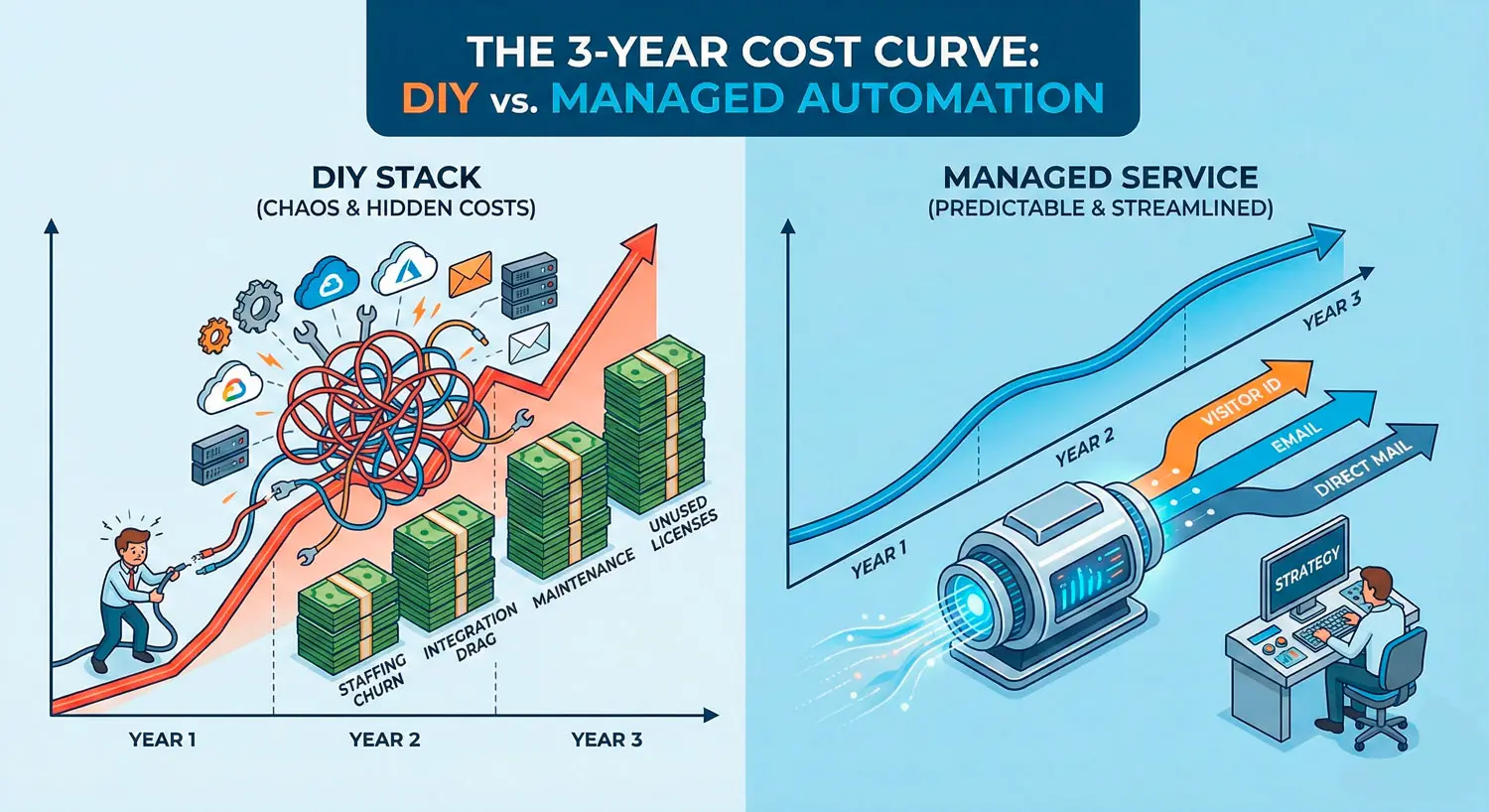
Decision Point – Side-by-Side 3-Year Cost Curve (DIY vs Managed)
This is where you build a simple but disciplined model.
Direct costs: licenses, services, and one-time fees
For each model, list:
DIY
- Yearly license costs for all tools involved.
- One-time implementation and consulting fees.
- Incremental infrastructure or data costs (e.g., storage, logs).
Managed
- Annual platform and service fees.
- Any onboarding or setup charges.
- Costs for add-ons (e.g., extra print volume) if applicable.
Reports on martech waste suggest a large share of licenses remain under-used—Gartner cites sub-50% utilization, and other analyses put the figure even lower. When you model direct costs, it’s worth explicitly calling out which tools you expect to deprecate if you go managed, not just what you add.
Indirect costs: internal hours, ramp-up, and campaign delays
Indirect costs typically include:
- Hours of marketing ops, dev, and analytics required to deploy and maintain the system.
- Time-to-launch for new journeys and tests.
- Lost revenue from campaigns that never make it out of planning.
Analysts emphasize that martech TCO must include integration work, training, underutilized features, and overlapping functionality—all driven by people, not software.
In your model, assign conservative values to:
- Hours per month spent on tool maintenance and troubleshooting under DIY vs managed.
- Average time from idea to live journey under each model (e.g., 3 weeks vs 3 months).
Scenario modeling for SMB, mid-market, and larger teams
To make it real, run three scenarios:
- SMB (lean team, modest traffic and deal size)
- Mid-market (growing team, higher volumes)
- Enterprise (large team, complex compliance)
For each, sketch:
- DIY: 3-year tool + people + replatform costs
- Managed: 3-year platform + services + reduced stack + staff focus on strategy
Then overlay a simple revenue model using conservative benchmarks:
- Email click-through rates often average around 2–3%.
- Direct mail response rates commonly sit in the 2–5% range, with some sources reporting ~3.6% averages and higher response to warm audiences.
The goal isn’t to predict exact revenue but to show that faster, more consistent launches of high-quality journeys (especially when combining digital + direct mail) can drive enough incremental value to justify a more predictable managed spend.
Where DIY Still Wins—and When It’s the Right Call
A fair comparison means admitting where DIY is the better strategic choice.
Unique data models or compliance needs
DIY can make more sense when:
- You operate in heavily regulated industries requiring bespoke data residency, encryption, or audit.
- Your data model is highly specialized, and generic platforms can’t keep up.
- You need deep integration with proprietary internal systems.
In these cases, building in-house may be the only viable route—as long as you model the staffing and TCO honestly.
Very large teams with robust, mature marketing ops
If you already have:
- A sizable, stable marketing ops and data engineering function.
- Strong documentation and governance practices.
- A culture of experimentation and continuous improvement.
Then a custom DIY vs managed automation decision can tilt toward DIY, especially when you can amortize builds across multiple brands or business units.
Hybrid models (DIY core + managed add-ons)
For many organizations, the sweet spot is hybrid:
- Keep a DIY core for CRM, analytics, and key internal data flows.
- Layer a managed visitor ID + email + direct mail service (MailX2-style) on top to handle high-value, cross-channel journeys.
This reduces stack complexity while preserving control where it matters most.
Mistakes That Skew the Cost Curve in the Wrong Direction
Mistake 1: Only counting year-one license fees
This is the classic error: comparing a first-year managed service quote to a license-only estimate for DIY.
To avoid it:
- Always include internal FTE time, onboarding, and integration when modeling DIY.
- Assume some rework or consolidation in years 2–3 (because it almost always happens).
Mistake 2: Underestimating the cost of delayed campaigns
The cost of a delayed or abandoned campaign is not “zero.” It’s the revenue and learning you didn’t capture.
If multi-channel journeys designed to:
- Rescue cart and form abandonment
- Re-engage “dead” leads
- Accelerate pipeline
launch six months late, that’s six months of incremental revenue you didn’t generate. Articles on martech stack consolidation emphasize how slow execution erodes ROI as much as overspending on tools.
Mistake 3: Assuming senior ops talent will stay forever
High-caliber marketing ops and revops talent is in demand, and turnover is real.
When a key architect of your DIY stack leaves, you pay in:
- Hiring costs
- Ramp-up time for replacements
- Risk of outages or mis-configured workflows
TCO thinking from martech leaders explicitly calls out people continuity as a core part of long-term cost.
Transformation – From “We’re Drowning in Tools” to “We Have a Growth Engine”
The operational feel of a lean, managed stack vs martech sprawl
Teams living with martech sprawl describe:
- Too many logins and dashboards
- Confusing ownership
- Analysis paralysis on which tools to use when
By contrast, a lean, managed stack feels more like:
- A small number of core systems everyone understands
- Clear accountability for cross-channel execution
- Fewer debates about tools and more about strategy
How teams reallocate time from plumbing to strategy and creative
When FocusCo hands more of the plumbing to a managed multi-channel provider, its team can reallocate time toward:
- Better offer and creative testing
- Sharper segmentation and ICP refinement
- Deeper collaboration with sales and product
Strategists and creatives stop acting as part-time integration engineers and start focusing on work that clearly shows up in revenue.
Governance, reporting, and forecasting in the “after” state
With a clearer cost structure and more consistent execution, forecasting becomes easier:
- Finance and leadership can see steady investment against measurable outcomes.
- Marketing can tie multi-channel journeys to pipeline and revenue metrics more credibly.
Instead of debating whether a tool is “worth it” in the abstract, everyone can look at a 3-year cost curve and a set of performance dashboards and decide together.
How to Run a 90-Day Evaluation Without Burning Bridges
You don’t have to rip out your stack or sign a three-year contract to test your options.
Choosing one journey or segment as the test bed
Pick a well-defined, high-value journey, for example:
- Abandoned carts or high-intent form abandonment
- High-value product or pricing page visitors
- A specific ABM segment
Then:
- Run your current DIY approach as the control.
- Stand up a managed multi-channel pilot (visitor ID + email + direct mail) in parallel for a comparable slice of traffic.
Setting success metrics: speed-to-launch, engagement, revenue
Define success in three dimensions:
- Speed-to-launch: how long from idea to live across DIY vs managed.
- Engagement: open/click for email, response for direct mail, site return visits. Benchmarks show email click-through rates around 2–3%, while direct mail response rates often fall between 2–5%, with higher rates for warm audiences.
- Revenue impact: incremental pipeline or revenue vs the control group.
Document everything so finance and leadership can see that you’ve measured both hard results and operational impact.
Building an internal decision memo CFOs and COOs will respect
At the end of 90 days, build a short internal memo that includes:
- A 3-year TCO comparison (DIY vs managed) including tools, people, and likely rework.
- Pilot results along the three dimensions above.
- Clear risks and trade-offs for each path.
The goal isn’t to make managed services “win at all costs;” it’s to make sure your DIY vs managed automation decision is grounded in numbers and operational reality, not just vendor demos or gut feel.
If you’re a resource-strapped team facing martech sprawl, a managed multi-channel service like MailX2—combining visitor identification, email, and direct mail execution—will often be the more predictable, defensible way to convert stack costs into a genuine growth engine.