







Most websites have a depressing pattern hiding in their analytics: a few form fills or purchases at the top… and a long, flat line of nothing underneath.
For a typical B2B or e-commerce site, only 1–3% of visitors ever convert on-site into a lead or customer. That means 90–99% of your traffic is anonymous website visitors who come and go without leaving a trace in your CRM.
At the same time, several studies show that the vast majority of first-time visitors are not ready to buy. One retail study found only about 17% of consumers browse an online store with immediate purchase intent; another found roughly 92% of first-time visitors to a retailer’s site aren’t there to buy at all.
Put those together and you get the core problem this article addresses:
Low onsite conversion is normal—but treating anonymous traffic as “waste” is optional.
In this piece, we’ll walk through a CFO-friendly model for valuing anonymous traffic, show how visitor identification and dual-channel follow-up (email + direct mail) change the equation, and give you a 90-day plan to test “the math” in your own business.
MailX2 sits squarely in this space: using visitor identification to deanonymize traffic, build profiles fast, and trigger automated email and direct mail within minutes of a visitor’s engagement. The goal here isn’t to pitch, but to show you whether this whole category is worth your attention—and, if so, how to evaluate it rigorously.
Why 90%+ of Your Visitors Disappear—and What That Really Costs
Low conversion isn’t a glitch in your funnel. It’s baked into how people research, compare, and procrastinate online.
The brutal math of traffic-to-lead conversion
Across many industries, landing-page conversion rates often hover near 1–3%, especially for higher-consideration B2B offers and SaaS.
Let’s use simple numbers:
- 50,000 website sessions per month
- 2% conversion to lead or purchase
- 1,000 “known” contacts or customers
- 49,000 visitors who come and go anonymously
Those 49,000 anonymous website visitors still:
- Cost you money (paid traffic, content, SEO, partnerships).
- Show intent (they took the time to visit, click, scroll, browse pricing, etc.).
- Disappear from your addressable audience the moment they leave.
If you only optimize that 2%—tweaking button copy, running A/B tests—you’re ignoring the far bigger question:
What would it be worth if even a sliver of those 49,000 ghost visitors became known, nurture-ready contacts?
Why “not ready to buy” ≠ “never going to buy”
First-visit “non-conversion” doesn’t equal zero potential.
Research on online shopping behavior shows:
- Only a minority of visitors intend to buy on their first visit.
- Many are comparing options, checking pricing, reading reviews, or simply browsing.
In B2B, the gap is even wider: multiple stakeholders, long buying cycles, and 90%+ of research done before a prospect talks to sales.
If those visitors don’t become part of your known audience, you have:
- No way to follow up when timing improves.
- No way to educate them, shape their criteria, or stay top of mind.
- No way to retarget them in channels that don’t depend on cookies (like email or direct mail).
The invisible opportunity cost of anonymous visitors
Imagine your average new customer is worth $2,000 in gross profit over their lifetime.
From 50,000 monthly sessions:
- At 2% onsite conversion, you get 1,000 leads.
- Let’s say 10% of those become customers over time.
- That’s 100 customers × $2,000 = $200,000 in lifetime gross profit generated from known contacts.
But what about the 49,000 anonymous visitors?
If even 0.5% of them could have become customers with better re-engagement, that’s:
- 245 additional customers
- 245 × $2,000 = $490,000 in gross profit
Not all of that is realistically recoverable. But this back-of-the-envelope math shows the magnitude of what’s at stake: anonymous traffic isn’t just “waste”—it’s your largest unrealized asset.
The Compounding Cost of Ghost Traffic Over 12–36 Months
The real damage from anonymous traffic is compounding, not linear. Each month you fail to convert more visitors into known contacts, you shrink your future retargeting pool.
Modeling “do nothing”: ad spend, traffic, and zero follow-up
Say you:
- Spend $50,000/month to generate those 50,000 sessions (blended CAC from SEO, paid, social, etc.).
- Continue to convert only 2% into leads.
- Ignore the remaining 98% after they leave.
Over 12 months:
- You’ve invested $600,000 in traffic.
- You’ve generated 12,000 leads (1,000 per month).
- You’ve let 588,000 visits come and go anonymously.
Even if only a small fraction of anonymous visitors had realistic buying potential over 12–36 months, the value of that “invisible cohort” can easily break into six or seven figures, depending on your deal size and LTV.
The pipeline that never forms
Ghost traffic also kills secondary value, like:
- Referrals you’ll never get because you never built a relationship.
- Upsells and cross-sells you can’t offer without an ongoing connection.
- Segment insights you never learn (what they browsed, where they dropped).
This is why first-party data is now described as the foundation of modern, privacy-first marketing and the primary asset in a cookieless retargeting world.
How small conversion lifts ripple over 3 years
Now flip the scenario. Suppose visitor identification and better follow-up let you:
- Turn an extra 0.5–1.0 percentage point of monthly visitors into known contacts (from 2% to 2.5–3%).
- Maintain roughly the same close rate from lead to customer.
From 50,000 visitors/month:
- At 2%: 1,000 leads/month → 100 customers/month (assuming 10% close).
- At 3%: 1,500 leads/month → 150 customers/month.
That’s 50 extra customers per month. Over three years, you’re looking at:
- 50 × 36 = 1,800 incremental customers
- At $2,000 gross profit each, that’s $3.6M in incremental lifetime value
Even if these numbers are cut in half—or in quarters—the compounding effect is clear. You don’t need heroic conversion lifts to justify taking anonymous traffic seriously.
Why “We Just Need More Traffic” Is the Most Expensive Lie in Marketing
When the pipeline feels thin, the reflex is always: “We need more traffic.” More spending. More channels. More campaigns.
The problem is, pouring more water into a leaky bucket just makes a bigger puddle.
When the funnel leaks faster than you can pour in budget
If you’re already converting 1–3% of visitors, doubling your traffic without fixing how you capture and nurture demand simply:
- Doubles your ad and content spend.
- Doubles the number of anonymous visitors you lose.
- Adds complexity to measurement and attribution.
That’s why many brands see ROAS plateau or decline even as spend grows. Benchmarks show that typical ROAS averages across digital channels are often modest—sometimes in the 1–2x range—especially once you factor in rising acquisition costs.
Proof from benchmarks: cost per lead vs conversion lift
Because conversion rates are so low to begin with, small downstream improvements often beat big traffic increases:
- If your visitor-to-lead conversion is 2%, increasing it to 3% is a 50% lift in leads from the same traffic.
- Achieving that with paid traffic alone would require a 50% budget increase at similar efficiency—rare in real-world ad auctions.
Studies of conversion benchmarks repeatedly emphasize that optimizing how you convert and nurture visitors drives better ROI than endless top-of-funnel expansion.
How focusing on anonymous visitors protects you from volatility
Traffic costs and algorithms change constantly. First-party data and a growing “known audience” are far more stable assets.
When you treat anonymous visitors as a core revenue lever, you:
- Depend less on any single ad platform.
- Build audiences you can reach directly (email, SMS, mail).
- Gain more signal about what’s working, even as third-party cookies fade.
Traffic still matters. But traffic without identity, consent, and follow-up is just noise.
What Visitor Identification Actually Changes in the Equation
Visitor identification is often misunderstood as a magic “close deals for you” button. It isn’t.
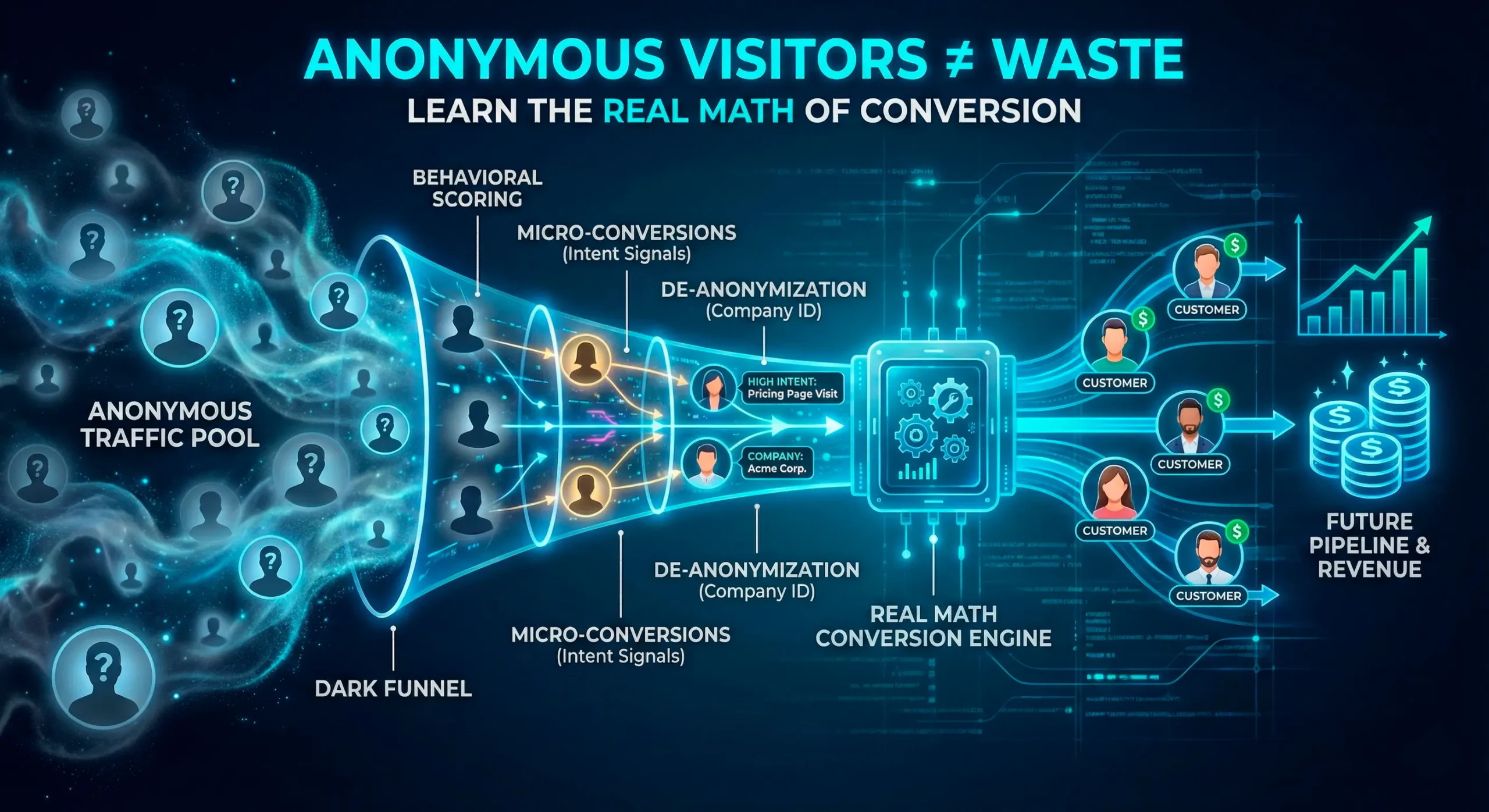
What it actually does is change the denominator in your marketing math: turning previously anonymous sessions into known, addressable people (or households) you can follow up with.
From unknown session to known contact: the core mechanics
At a simplified, non-technical level, a visitor ID platform like MailX2 typically:
- Recognizes a visitor using privacy-compliant data sources and identity graphs (e.g., hashed emails, postal data, device/household signals).
- Matches that visitor to a profile containing contact info and behavioral attributes.
- Triggers automated workflows—email, direct mail, or both—based on rules you define (e.g., visited pricing page, abandoned cart, viewed a high-intent content asset).
You end up with more people entering your CRM and marketing automation, even if they never filled out a form.
Where email + direct mail plug into this new “known audience”
Once you can identify more of your visitors, you can:
- Send timely emails that pick up where the session left off (e.g., reminding them of viewed products or content, inviting a demo, offering a resource).
- Trigger direct mail—postcards or letters—when the expected value (AOV, LTV) justifies the higher cost.
Direct mail matters here because response benchmarks are often meaningfully higher than email:
- Email campaign response rates commonly sit around ~0.5–1%.
- Direct mail response rates frequently fall in the 2–5% range across many sectors.
That doesn’t mean you blanket everyone with postcards. It means you pair cheap, scalable email with selective, high-impact mail for your best segments.
Privacy and perception: making it feel helpful, not creepy
Visitor ID and offline retargeting must be implemented with:
- Clear consent wherever possible (e.g., preference centers, opt-ins).
- Transparent value (“We’ll send you personalized offers and helpful reminders, not spam”).
- Compliance alignment (GDPR, CCPA, and local privacy laws).
The goal is not to make visitors feel surveilled; it’s to meet them with relevant follow-up in channels they can easily ignore or accept. MailX2 or any serious provider should be able to explain their data sources, legal basis, and opt-out mechanisms in plain English.
Decision Point – When Visitor Identification Makes Financial Sense (and When It Doesn’t)
Visitor ID isn’t a universal must-have. There are clear thresholds where it starts to make sense—and situations where you should wait.
Minimum viable traffic and deal size
In rough terms, the economics tend to work best when you have:
- Meaningful monthly traffic (e.g., thousands to tens of thousands of sessions, not hundreds).
- Reasonable average deal size or AOV (so incremental conversions actually move the needle).
- A sales or marketing team that can follow up on the opportunities you generate.
If you’re pre-traffic, pre-product-market-fit, or selling ultra-low-margin goods, your money is often better spent fixing the basics first (site experience, offer, product, messaging).
Scenarios where you should not invest yet
Visitor ID may not be right for you (yet) if:
- You’re getting <5,000 sessions/month and don’t plan to grow that quickly.
- Your average order or deal value is tiny, and there’s no clear path to LTV.
- You lack any capacity to build journeys, content, or follow-up (even with a managed partner).
- Your audience is highly niche or heavily regulated and requires bespoke outreach.
In these cases, simpler improvements (better forms, clearer offers, faster load times, basic email nurturing) should come first.
Checklist: If you answer “yes” to 4+ of these, it’s time to run the numbers
- We have at least 10,000+ monthly sessions, and they’re not converting as we’d like.
- Our average customer LTV justifies even small conversion lifts.
- We already run email campaigns but suspect our list is only a fraction of our real audience.
- Our paid media and SEO budgets are material—and we’d like better ROI.
- Leadership is willing to test a 90-day pilot with clear success metrics.
If that’s you, visitor identification and dual-channel automation are at least worth a test.
Building the ROI Model: From Traffic to Incremental Revenue
You don’t need a new tool to decide whether this category is worth exploring. A spreadsheet and conservative assumptions are enough.
Step 1: Define your inputs
At minimum, you’ll need:
- Monthly sessions (by key segment if possible).
- Current visitor-to-lead conversion rate (form fills, signups, calls).
- Lead-to-customer rate and average deal size / AOV.
- Gross margin (or contribution margin) to translate revenue into profit.
Benchmarks and your own data will show that conversion rates are low—often in that 1–3% range.
Step 2: Choose conservative assumptions for the uplift
For visitor ID + email + direct mail, you’ll need assumptions for:
- Match rate (what % of anonymous visitors can be identified).
- Engagement rates on triggered email and mail.
- Incremental conversion rate from those re-engagements.
Direct mail response benchmarks of 2–5% vs email around 0.5–1% are a reasonable starting point, but your model should err on the low side—e.g., 2% for mail and 0.5% for email.
Your model might say:
- We’ll identify 10–20% of anonymous visitors.
- Of those, X% will respond meaningfully (click, visit again, engage).
- Of responders, Y% will become customers.
Step 3: Calculate incremental leads, revenue, and payback
With those assumptions, you can compute:
- Incremental known contacts per month.
- Incremental customers per month.
- Incremental monthly gross profit.
Then compare that to:
- The platform + service cost (visitor ID + automation).
- Any internal cost (time spent, content created, etc.).
You’re looking for:
- A realistic payback period (e.g., within 6–18 months depending on your risk tolerance).
- A decent ROI multiple vs continuing to spend the same money solely on traffic.
If the numbers only work with heroic assumptions, the timing isn’t right. If they work with conservative ones, you have a strong case for a pilot.
Common Mistakes When Calculating “The Math” (and How to Avoid Them)
The math itself isn’t hard. The biases are.
Mistake 1: Using best-case response rates instead of realistic ranges
Optimistic teams:
- Plug in the top end of benchmark ranges (e.g., 5%+ direct mail response).
- Assume strong match rates and high close rates.
The fix:
- Run models with low, mid, and high cases.
- Make decisions based on the low-to-mid scenarios.
Mistake 2: Ignoring lifetime value, referrals, and repeat purchase
Pessimistic teams often:
- Only count the first purchase or contract.
- Ignore expansion revenue, renewals, and cross-sell.
The fix:
- Use at least a 1–3 year LTV window where appropriate.
- Still be conservative, but don’t pretend every customer is one-and-done.
Mistake 3: Treating visitor ID as a stand-alone channel instead of an amplifier
Visitor ID doesn’t replace email, direct mail, or sales. It amplifies them by feeding those channels more (and better) people.
If you measure it in isolation (“How many deals came solely from this?”), you under-count its impact.
The fix:
- Attribute value based on incremental lift in key outcomes (pipeline, revenue, LTV) vs a control group that doesn’t receive identified-visitor follow-up.
Transformation – What Changes Once Anonymous Visitors Become a Known Audience
If you get this right, the biggest change isn’t in your tech stack. It’s in how your organization thinks about demand.
From cold outreach to warm, behavior-informed outreach
Instead of:
- Buying cold lists.
- Hammering strangers with generic sequences.
You focus on:
- People who chose to visit your site.
- What they actually looked at (products, content, pricing).
- Where they are in the journey (research, comparison, renewal, etc.).
Sales conversations feel less like interruptions and more like continuations.
Sales pipeline predictability and better forecasting
With more known contacts entering the top of the funnel and better nurture flows, you:
- See more consistent lead volume month to month.
- Get better data on conversion stages.
- Can forecast more confidently, even as ad platforms fluctuate. (Salesforce)
Strategic freedom: safer experimentation at lower risk
A larger, richer house file lets you:
- Test new offers on segments instead of blasting unknown audiences.
- Shift spend away from underperforming traffic sources with less fear.
- Build owned channels (email, mail, community) that outlive any algorithm.
In short: you move from chasing impressions to managing assets.
Implementation Snapshot – How to Test the Math in 90 Days
You don’t need a multi-year transformation program to get started. A focused 90-day pilot is enough to see if the economics hold up.
Step 1: Pick a segment and traffic slice to test
Choose a segment where:
- Traffic volume is meaningful.
- Deal size/AOV supports incremental investment.
- The journey is understandable (e.g., product X buyers, demo requests, specific industry vertical).
Restrict your pilot to one or two key journeys (e.g., pricing page visitors, cart abandoners) so you can isolate impact.
Step 2: Define success metrics
For a 90-day test, track:
- Increase in known contacts (from visitor ID and triggered touchpoints).
- Engagement metrics (open, click, site return, QR scans, etc.).
- Pipeline and revenue lift vs a comparable control group that doesn’t receive identified-visitor follow-up.
Make sure your analytics and CRM can differentiate pilot vs control contacts.
Step 3: Use a managed platform like MailX2 to reduce friction
If your team is lean or stretched thin, a managed platform such as MailX2 can:
- Handle visitor identification setup and integrations.
- Design and launch dual-channel journeys (email + direct mail) on your behalf.
- Provide reporting focused on incremental lift, not vanity metrics.
That lets you focus on evaluating the business case, not wrestling with pixels, print specs, or postal logistics.
Step 4: Decide based on evidence, not hype
At the end of 90 days, ask:
- Did we see meaningful lift in known contacts, pipeline, or revenue vs the control?
- Do the numbers look good under conservative assumptions?
- Is the impact strong enough to justify rolling out to more segments?
If yes, scale gradually. If no, you’ve bought clarity cheaply—and can redirect the budget to higher-yield levers.
Bringing It Together—and What to Do Next
Anonymous website visitors aren’t a rounding error. They’re the majority of the people your marketing works so hard to attract.
The “real math” says:
- Low onsite conversion is normal—but permanent anonymity is optional.
- Small improvements in how you convert and nurture visitors compound over years.
- Visitor identification plus dual-channel automation can shift your economics from “pay forever for traffic” to “build a durable, owned audience.”
If you’re ready to see what the numbers might look like for your own site, there are two practical next steps.
Request a Visitor ID ROI Snapshot
If you’d rather have experts run the numbers with you, request a Visitor ID ROI Snapshot from a provider like MailX2. You’ll walk away with a clear, data-driven view of whether anonymous traffic is your most under-leveraged asset—or whether your budget belongs elsewhere for now.
Either way, stop treating 90%+ of your traffic as ghosts. Start treating it as the pipeline you haven’t built yet.